

“As far as $200 billion. I think that number could move. Obviously, it takes money to kill bad guys.”
That was Defense Secretary Pete Hegseth on C-SPAN, March 19, 2026. Bright lights, pressed suit, the casual shrug of a man spending someone else’s money.
Now hold that quote next to this one: On February 28, 2026 — Day One of the U.S.-Israeli war on Iran — a missile tore through Shajareh Tayyebeh Elementary School in Minab, a two-story building painted with pink flowers and green leaves. The roof collapsed. Parents who had rushed to pick up their children were buried alongside them. 175 people were killed, most of them children between the ages of 7 and 12 — schoolgirls, teachers, and the mothers who were still running toward the building when it fell.
The Pentagon was asked about Minab. Trump blamed Iran. The White House said the investigation was “ongoing.” A preliminary military investigation found that U.S. Central Command used outdated intelligence data when it put the school on its target list.
Nobody has been held accountable. Nobody will be.
But the Pentagon did find $200 billion it needed in a hurry.
The Number That Should Stop You Cold
The math here is not complicated, which is exactly why the political press refuses to do it.
The Pentagon has formally requested White House endorsement for a supplemental war funding package exceeding $200 billion, on top of the $839 billion it already received for FY2026. That’s $200 billion — not for the whole year, not for a global counter-terror enterprise, not for two wars simultaneously. That’s a supplemental emergency ask for Week Three of a single conflict.
Let me put that in terms that mean something. The federal government’s total projected outlays for FY2026 are $7.4 trillion, against revenues of $5.6 trillion and a deficit already running at $1.9 trillion. The enacted defense budget is $839 billion. This $200 billion supplemental is roughly 24% of that defense budget — nearly a quarter of what America already spends on the most expensive military on earth — requested in a single emergency ask for Week Three of a single conflict. Stack it against the rest of the ledger: the federal government will spend approximately $1 trillion on net interest alone in FY2026, more than the base defense budget. They are now asking to borrow another $200 billion on top of that, before most Americans have figured out what country we’re actually at war with.
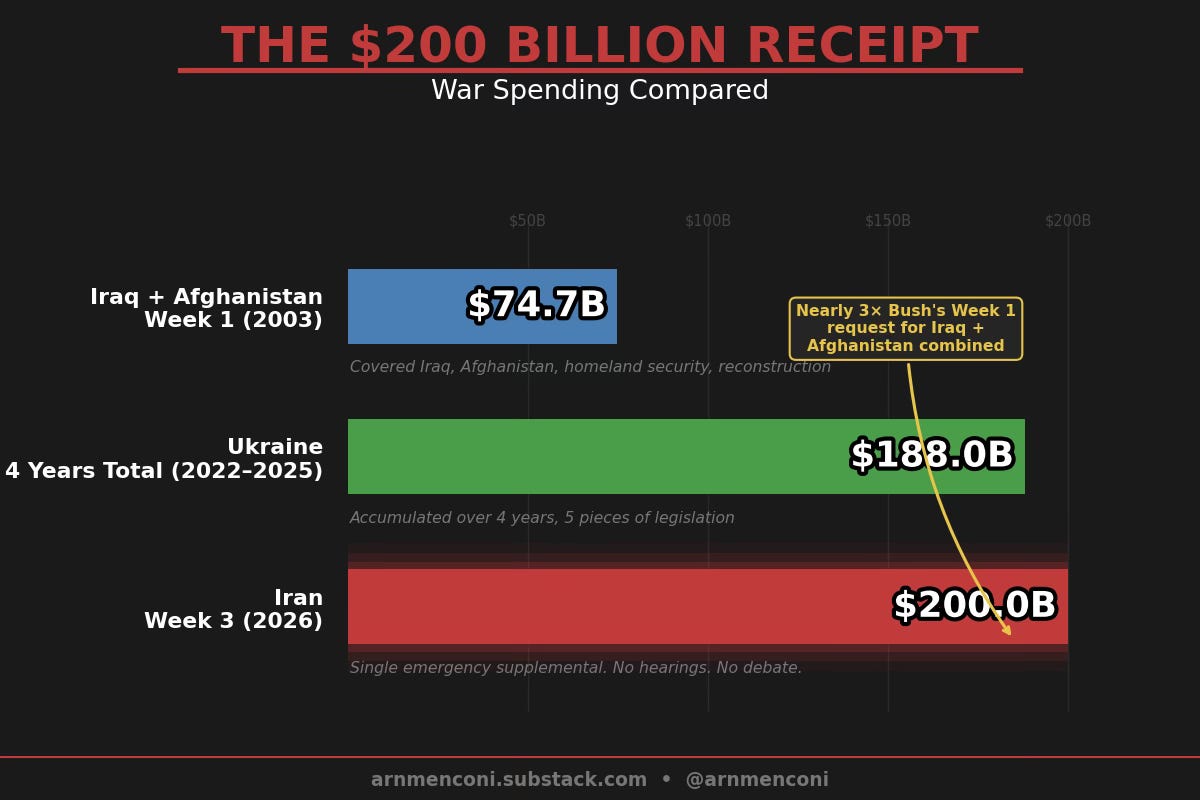
Now compare it to the Iraq War. On March 25, 2003 — five days after boots crossed the Iraqi border — George W. Bush went to Congress with his first wartime emergency supplemental. That request was $74.7 billion, and it covered Iraq, Afghanistan, the global war on terror, domestic homeland security, and reconstruction combined. Congress approved $78.49 billion. The Bush administration’s pre-war cost projection for Iraq alone was $50 to $60 billion total. “If anything, that estimate was too low,” wrote Nobel laureate Joseph Stiglitz and Harvard’s Linda Bilmes in 2010. The real number, they calculated, was $3 trillion. Brown University’s Costs of War Project puts total U.S. expenditures in Iraq and Syria — including projected veterans’ care through 2050 — at $2.89 trillion, with direct costs to date at $1.79 trillion, and a human toll of 550,000 to 580,000 killed.
The $200 billion being requested right now, in Week Three of Iran, is nearly three times what Bush asked for in Week One of Iraq plus Afghanistan combined.
Still with me? Good. Now compare it to Ukraine. Trump and the Republican Party spent three years treating every Ukraine appropriation as an act of treason against American workers. They were not entirely wrong to ask questions. But the total U.S. spending on Ukraine through the end of 2025 was $188 billion — accumulated over four years, across five separate pieces of legislation, with 42% still not even disbursed as of December 31, 2025. The screaming about Ukraine from the right was endless.
They are asking for more than that in Week Three of Iran. No hearings. No debate. No competing plans. Just: “It takes money to kill bad guys.”
March 20 — The Anniversary Nobody Wants to Commemorate
Today is March 20, 2026. Twenty-three years ago, American bombs started falling on Baghdad. I want you to remember the story you were told in 2003 and compare it to the story being told right now, because I’ve been watching the government do this for two decades and the script barely changes.
In 2003 the threat was imminent. WMDs. Mushroom clouds over American cities. Rumsfeld said the war would pay for itself through Iraqi oil revenues. The cost was projected at $50 billion, maybe $60 billion. Congress was told the CIA had proof. Colin Powell went to the United Nations with a PowerPoint and his personal credibility and spent both. The actual cost to the United States runs between $1.9 trillion and $3 trillion, depending on how many zeroes you want to count, and 550,000 to 580,000 people are dead.
In 2026 the threat was imminent. Iran’s nuclear program. An assassination that hadn’t happened yet. Trump said the U.S. was “very nearly under threat.” Marco Rubio backed the story. The cost projections were — well, nobody gave cost projections, because they’d learned not to bother with projections that will embarrass you later.
Then Joe Kent opened his mouth.
Kent was the Director of the National Counterterrorism Center — Trump’s principal counterterrorism adviser, confirmed by the Senate in a party-line vote. He resigned this week. He didn’t go quietly. In a nearly two-hour interview with Tucker Carlson, Kent said the following: “The Israelis drove the decision to take this action, which we knew would set off a series of events, meaning the Iranians would retaliate.” He said “there was no intelligence that said, hey, on whatever day it was, the Iranians are going to launch this big sneak attack — they’re going to do some kind of 9/11, Pearl Harbor — there was none of that intelligence.” He said a significant number of key decision-makers were not allowed to present their views to the president. In his resignation letter, Kent accused Israel of mounting a “misinformation” campaign to “deceive” Trump into launching the war, and blamed the decision on “pressure from Israel and its powerful American lobby.”
This was not some fringe dissenter. This was the sitting director of the National Counterterrorism Center, a combat veteran with 11 deployments, saying in plain English: there was no imminent threat, and Israel drove the decision.
The White House called it “insulting and absurd.” Trump said Kent was “weak on security.” The Wall Street Journal and ABC News reported the interview. The interview, which quickly went viral, was heard directly by millions.
The pattern here is not subtle. AIPAC spent over $100 million in the 2024 election cycle targeting candidates critical of Israel. Israeli Prime Minister Netanyahu personally lobbied Trump. According to Kent, Israeli officials fed intelligence to Trump that U.S. intelligence could not verify and that did not align with what U.S. agencies were actually seeing. “When we listened to what they were saying,” Kent told Carlson, “it did not align with intelligence channels.”
Oman’s Foreign Minister Badr Albusaidi — the diplomat who personally mediated the most recent indirect nuclear negotiations between Washington and Tehran — wrote in The Economist that the United States “has lost control of its own foreign policy” and that the strike was “a shock but not a surprise.” He noted that twice in nine months, a genuine diplomatic deal had been within reach, and that the war began hours after the “latest and most substantive talks.” He called Iran’s retaliation “an inevitable, if deeply regrettable and completely unacceptable, result” — saying it was “probably the only rational option available to the Iranian leadership.” He warned that Israel’s goal of regime change would require a prolonged ground campaign, “a new front in the forever wars which President Donald Trump previously vowed to end.” His conclusion: Washington’s greatest miscalculation was “allowing itself to be drawn into this war in the first place.”
Daniel Ellsberg — who I spent 40 hours interviewing across 10 days at his home in 2015 — spent the last decades of his life warning that the secrecy and lies that drove the Vietnam War never went away, they just migrated into better packaging. He was right. The packaging today is sharper, the lies are faster, the price tag has nine more zeros, and the schoolgirls in Minab are just as dead as the ones in My Lai.
Follow the Money: The Energy Math
Political analysis doesn’t understand how to follow the money. They don’t understand budgets, military or otherwise. So let me do it for you.
When the Strait of Hormuz closes, roughly one-fifth of the world’s oil supply disappears from the market. That’s not a talking point — that’s a physical chokepoint connecting the Persian Gulf to the Arabian Sea, and as of this writing it is effectively closed, with maritime traffic halted except for limited vessels from India, Pakistan, Turkey, and China. OCBC Group estimates a daily shortfall of approximately 10 million barrels even accounting for strategic reserve releases.
Brent crude was trading around $70 a barrel before the conflict. It crossed $100. It was over $108 Wednesday. Thursday it surged past $112, and benchmark Middle Eastern grades — Oman, Dubai — have already cleared $150. “Benchmark Middle Eastern oils like Oman and Dubai have already surpassed the $150 mark, making $200 a realistic target,” Vandana Hari of Vanda Insights told Al Jazeera. Oxford energy expert Adi Imsirovic called $200 oil “entirely feasible.”
It is not just oil. Israel struck Iran’s South Pars gas field — responsible for 70% of Iran’s gas output. Iran retaliated by striking energy infrastructure in Qatar, Saudi Arabia, the UAE, and Kuwait, and halted all gas exports to Iraq. Dutch TTF natural gas prices surged 25% on March 19 alone, to €68/MWh — up 118% over four weeks from a pre-conflict level around €30-32. EU diesel is up 20% on a weighted average. Spain is up 27%. Diesel is exceeding €2 per liter across multiple European countries.
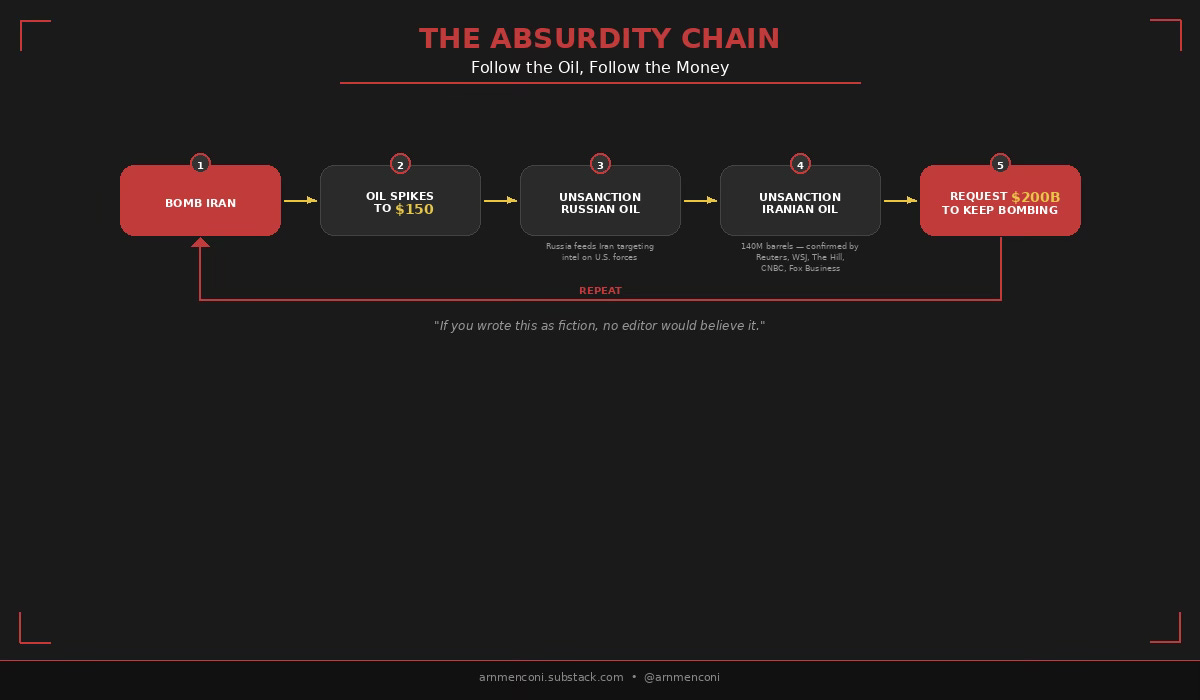
And just when you thought the absurdity had a ceiling, it doesn’t. On March 19, Treasury Secretary Scott Bessent confirmed that the administration is considering allowing the sale of approximately 140 million barrels of Iranian oil currently stranded on tankers — oil from the country the United States is actively bombing. “In the coming days, we may unsanction the Iranian oil that’s on the water,” Bessent told Fox Business Network, a statement independently confirmed by The Wall Street Journal, The Hill, CNBC, and The Daily Beast. This comes one week after Bessent gave India a 30-day waiver to purchase Russian oil stranded at sea — Russian oil, from the country currently providing Iran with intelligence on U.S. military asset locations, according to a letter from senior House members to Bessent himself. Follow the chain: bomb Iran → oil spikes to $150 → unsanction Russian oil (Russia is helping Iran target American troops) → unsanction Iranian oil (the country being bombed) → request $200 billion to continue bombing. If you wrote this as fiction, no editor would believe it.
I want you to be very precise about who benefits from $200-a-barrel oil. It is not the truck driver hauling freight on I-70 through the Eisenhower Tunnel. It is not the family heating their home in Pueblo on a fixed income. It is not the Iranian children who were in school on February 28th. It is sovereign wealth funds, commodity desks, energy majors, and the politicians whose campaigns they fund. War is not just expensive — it is profitable, for a very specific set of people, and those people are not the ones being bombed.
The Arsenal Is Empty and the Invoice Is Already Printed
Now let me show you the part they hoped you wouldn’t read.
The Economist’s Gregg Carlstrom reported this week that the cost of replacing just the first four days’ worth of munitions is $20 to $26 billion. Not the whole war. Four days. The problem, he wrote, “is more to do with scarcity than cost.” The United States fired more than 300 Tomahawk cruise missiles in the opening days of the war. The Pentagon had planned to buy 57 new ones this fiscal year. Over the past five years, the military has purchased just 322 total. At $2.2 to $3.5 million per missile, the U.S. spent $5.6 billion on munitions in the first two days alone. For context, during Operation Iraqi Freedom in 2003, the U.S. launched roughly 800 Tomahawks during the entire initial invasion. At today’s production rate, that would take a decade to replenish.
It gets worse. There have been no deliveries of THAAD interceptors to the United States since July 2023. The Pentagon has not placed any new orders this year. A total of 39 interceptors are slated for delivery in 2027 — six years after they were ordered. Before this war, the U.S. THAAD stockpile was estimated at 534 interceptors with 150 spares. During the June 2025 Israel-Iran exchange, the U.S. Army reportedly expended between 100 and 250 of those interceptors, potentially erasing the entire spare inventory. Each THAAD interceptor costs $12 to $15 million. They are not making more fast enough. They won’t be for years.
Meanwhile, Iran has been spending $20,000 to $50,000 per drone while the U.S. and Gulf states spend $300,000 to $4 million per interception. CSIS analyst Kelly Grieco calculated that “for every $1 Iran spent on drones, the UAE spent roughly $20 to $28 shooting them down.” The Economist’s Carlstrom called it “using Ferraris to intercept e-bikes.” Iran’s total outlay attacking the UAE through early March was between $177 million and $360 million. The UAE’s interception cost: $1.45 to $2.28 billion. Iran is draining American and allied arsenals at a ratio of roughly 25 to 1.
So what did the Pentagon do? On March 19, Secretary of State Marco Rubio signed emergency waivers to bypass congressional review and fast-track $16.5 billion in arms sales to the UAE, Kuwait, and Jordan. The UAE gets $4.5 billion for a THAAD long-range radar, $2.1 billion for counter-drone systems, $1.22 billion in air-to-air missiles, and $644 million in F-16 upgrades. Kuwait gets $8 billion in LTAMDS missile defense radars. Jordan gets $70.5 million for aircraft support. The prime contractors: RTX (Raytheon), Lockheed Martin, Northrop Grumman. No congressional debate. No review period. Hegseth praised the arrangement, saying Gulf states have now been brought “squarely into our orbit.”
Read that sentence again. “Squarely into our orbit.” That is not the language of defense. That is the language of a protection racket. We bomb the region. The region’s defenses get overwhelmed. We sell them replacements on an emergency basis, bypassing the only body constitutionally authorized to oversee arms sales. The contractors who build the weapons are headquartered in the same states — Texas, Alabama, Arizona, Colorado — whose congressional delegations will vote for the $200 billion supplemental. Colorado alone is home to Lockheed Martin’s Waterton Canyon complex, Raytheon operations in Aurora and Colorado Springs, Northrop Grumman’s space systems, the Air Force Academy, Peterson and Schriever Space Force bases, and the headquarters of U.S. Space Command. The money doesn’t just cycle through Washington. It cycles through specific zip codes, and the people in those zip codes know exactly where the next contract is coming from.
Iran has struck at least 10 allied radar sites across seven countries since the war began, including damage to multiple AN/TPY-2 radars that support the THAAD system and a $1.1 billion AN/FPS-132 radar in Qatar. The UAE’s missile defense penetration rate surged from 5% to 25% on March 10 alone. After that, the UAE stopped publishing complete data. Every radar destroyed is a radar that needs replacing. Every replacement is a contract. Every contract is a line item that will be folded into the supplemental or the next arms sale or both.
This is not defense spending. This is an industrial production cycle that requires war to sustain itself.
The OMNIparty: How Congress Trades on Its Own Wars
Stop calling it left versus right. That frame is how they hide the mechanism.
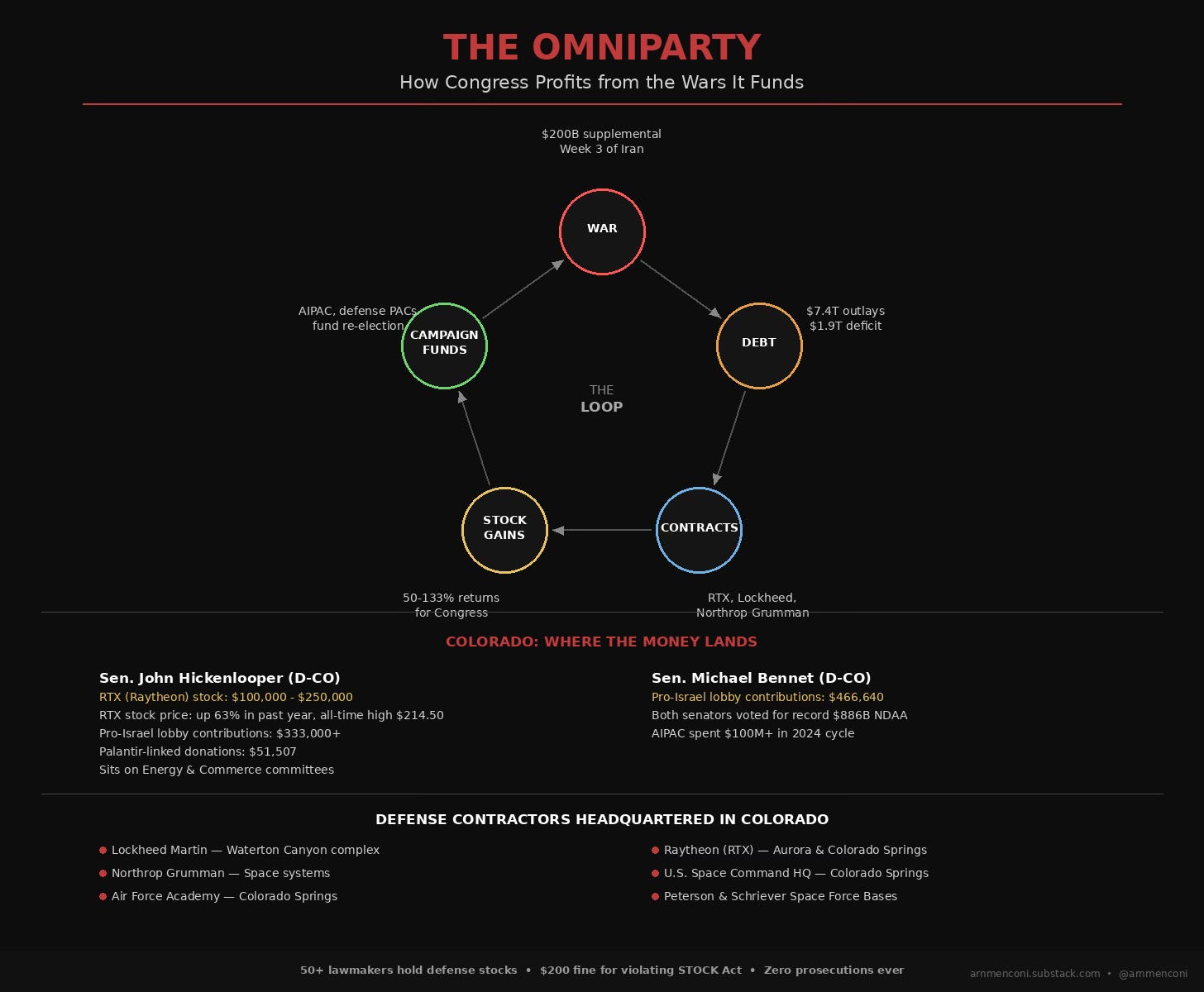
Sen. John Hickenlooper (D-CO) holds between $100,000 and $250,000 in RTX stock — formerly Raytheon, the company that makes the Tomahawk missiles and Patriot interceptors at the center of the Iran war — held since his election in 2020. RTX hit an all-time high of $214.50 on March 3, 2026, up 63% in the past year. The company posted $88.6 billion in 2025 revenue with a backlog of $268 billion. Over 300 RTX-built Tomahawk missiles were fired in the opening days of the war on Iran. Hickenlooper sits on the Energy and Commerce committees. He is not a defense hawk by campaign biography. He’s a Democrat from Colorado. He also holds a quarter-million dollars of the company that made those missiles.
Hickenlooper also received over $333,000 from AIPAC and allied groups, and an additional $51,507 in Palantir-linked donations. His Colorado colleague Sen. Michael Bennet has received approximately $466,640 from pro-Israel PACs since 1990. Neither man has called for a pause. Neither has requested an independent accounting of the $200 billion. Neither has publicly acknowledged owning stock in the companies building the weapons their votes fund.
Hickenlooper is not an anomaly. He is the template.
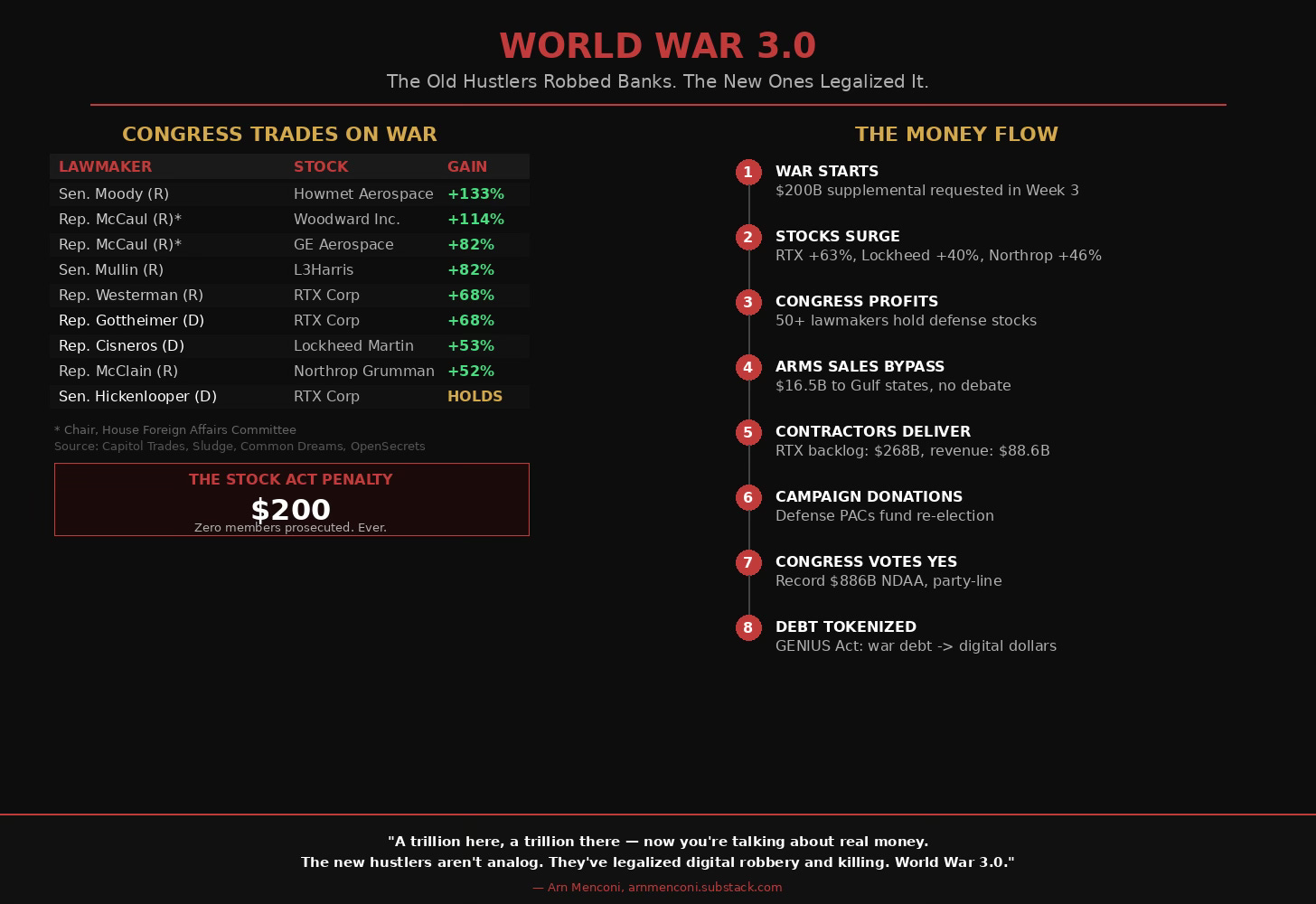
Capitol Trades analysis found dozens of congressional defense stock purchases in 2025 that surged 50 to 133% after the war began on February 28, 2026. The specifics are not abstract: Sen. Ashley Brooke Moody holds Howmet Aerospace, up 133%. Rep. Michael McCaul — Chair of the House Foreign Affairs Committee — holds Woodward Inc., up 114%, and GE Aerospace, up 82%. The man who chairs the committee that oversees the authorization of military force holds stock in companies that manufacture components for military aircraft. Sen. Markwayne Mullin holds L3Harris, up 82%. Reps. Westerman and Gottheimer both hold RTX, up 68%.
More than 50 U.S. lawmakers hold defense contractor stocks. All 13 senators with defense stock holdings voted for the most recent National Defense Authorization Act — the $886.3 billion version. The most widely held defense stock in Congress is Honeywell, which makes sensors and guidance systems used in Israeli airstrikes in Gaza. The second most widely held is RTX, which makes Iron Dome interceptors and the Tomahawks currently being fired at Iran.
Since Trump’s election win, at least 19 members of Congress bought defense stocks, per Sludge analysis. They watched those stocks rise as the bombs dropped. This is the documented, public record.
The penalty for failing to disclose a stock trade under the STOCK Act — the law Congress passed in 2012 to demonstrate it took ethics seriously — is $200. Not $200,000. Not a percentage of the undisclosed gain. Two hundred dollars. The number of members of Congress ever prosecuted under the STOCK Act: zero. The number who have faced any consequence at all for late or non-disclosure: a handful, with fines that amount to rounding errors on their portfolios. The compliance mechanism for America’s most powerful financial conflict-of-interest law is a fine smaller than a parking ticket in a major city.
Meanwhile, between 2020 and 2025, top defense contractors spent $110 billion on stock buybacks and dividends — more than double their capital expenditures. They are not building more capacity. They are returning capital to shareholders — many of whom sit in the United States Senate. The production lines that can’t keep up with demand? That’s a feature, not a bug, if you’re holding the stock. Scarcity keeps prices elevated. An empty arsenal is a guaranteed future contract.
Colorado makes this legible at the state level. Lockheed Martin’s Waterton Canyon. Raytheon in Aurora and Colorado Springs. Northrop Grumman’s space systems division. The Air Force Academy. Peterson and Schriever Space Force Bases. U.S. Space Command headquarters. The $200 billion supplemental flows from the Treasury to the Pentagon to the contractors to their stock prices to the congressional portfolios of members who vote for the next NDAA to the campaign war chests that fund the next election to the votes that authorize the next war. The loop closes completely. It has no exit.
This is the OMNIparty. Not a party of ideology — a party of portfolio. Democrats like Hickenlooper hold Raytheon stock and cash AIPAC checks. Republicans like McCaul chair the Foreign Affairs Committee while holding GE Aerospace. They disagree on taxes, transgender athletes, and the border. They do not disagree on the NDAA. They have never disagreed on the NDAA. The NDAA passes every single year, without exception, regardless of which party controls the chamber, regardless of what is happening in the world, regardless of what the intelligence community actually said about the threat.
The OMNIparty is not a conspiracy. It is a system. Systems don’t require coordination — they require alignment of incentives. When the incentives of both parties point at the same set of contractors, you don’t need a backroom deal. You just need a vote.
The GENIUS Act: How They Intend to Pay for All of This Forever
Now here is where it gets elegant, in the way that Ponzi schemes are elegant before they collapse.
The United States will pay approximately $1 trillion in net interest on its national debt in FY2026— more than the entire $839 billion base defense budget before supplementals. The debt held by the public stands at over $32 trillion and climbing. They are now asking to borrow $200 billion more. This is not a budget. This is a tab.
In July 2025, Trump signed the GENIUS Act — the first federal regulatory framework for stablecoins. The White House’s own fact sheet states explicitly that the Act “will generate increased demand for U.S. debt and cement the dollar’s status as the global reserve currency by requiring stablecoin issuers to back their assets with Treasuries and U.S. dollars.” The Act requires 100% reserve backing with liquid assets — U.S. dollars or short-term Treasuries. Every dollar that flows into the stablecoin market is, by federal mandate, a captive buyer of U.S. government debt.
Follow the chain: war → emergency supplemental → Treasury issues new debt → GENIUS Act requires stablecoin issuers to buy those Treasuries as reserves → war debt gets a permanent, mandated buyer pool → interest payments grow → repeat.
This is not a conspiracy theory. This is the stated policy goal, in the White House’s own words. “Stablecoins will play a crucial role in ensuring the continued global dominance of the U.S. dollar as the world’s reserve currency.”
What they’re building is a feedback loop that converts military spending into financial architecture. The war creates the debt. The debt creates the Treasuries. The Treasuries get tokenized into the digital dollar system. The digital dollar system is then exported globally as the reserve infrastructure of the next financial era. The war pays for itself — not in Iraqi oil, as Rumsfeld promised, but in captured Treasury demand, permanently baked into the regulatory framework of a $2 trillion and growing stablecoin market.
The people who understand this are not in the Senate Armed Services Committee. They are at BlackRock. They are at Fidelity Digital Assets. They are in Singapore and Abu Dhabi. They are the ones who helped write the GENIUS Act, and they understand exactly what a $200 billion war supplemental does to Treasury issuance.
Who Actually Benefits?
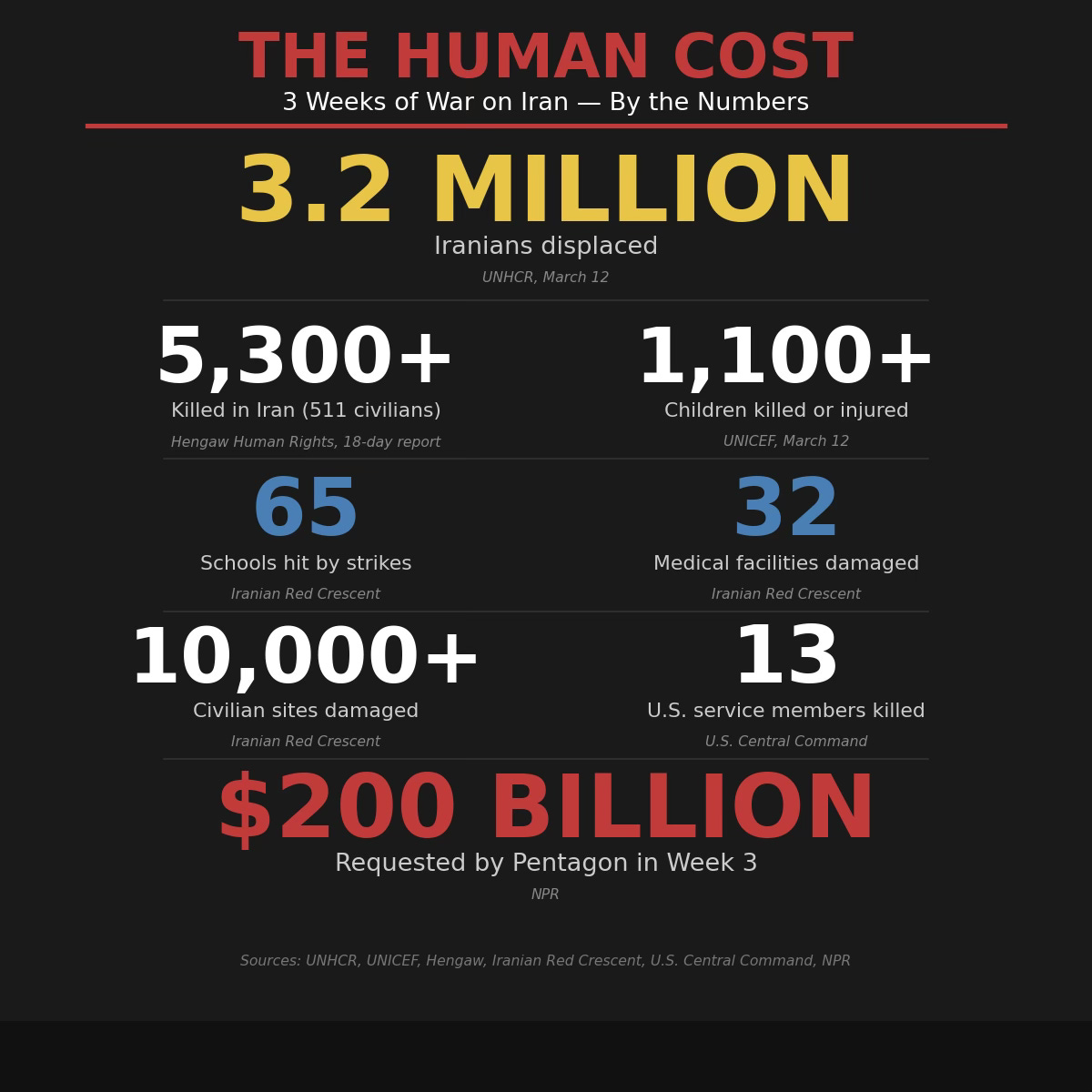
Not you. Not the Iranian schoolgirls. Not the truck driver in Grand Junction paying $5 for diesel. Not the veterans who will be counting their traumatic brain injuries in 2040 while Congress debates whether to fully fund the VA.
The war has already cost the United States more than $18 billion as of March 19, burning at approximately $500 million per day according to CSIS analysts. Over 15,000 sites have been targeted in two weeks. Over 3,000 Iranians are confirmed dead. U.S. munitions stockpiles have been significantly depleted — which, of course, will require restocking, which will require defense contracts, which will require funding, which is what the $200 billion supplemental is partially for.
The beneficiaries are defense contractors currently at all-time stock highs. They are energy companies whose commodity books are printing money on every barrel above $80. They are asset managers with sovereign wealth clients who are rotating into dollar-denominated instruments as the stablecoin regulatory framework creates a new captive Treasury buyer class. They are digital infrastructure companies building the rails for the tokenized Treasury market. They are, in short, the same people who benefited from Iraq, from Afghanistan, from every supplemental appropriation that Congress rubber-stamped in the name of national security while the actual national security professionals — like Joe Kent — were being told to shut up and sit down.
Zelensky said in February 2025 that the entire Ukraine war cost $320 billion, with Ukraine paying $120 billion and the U.S. and EU covering the remaining $200 billion combined. The political class spent three years screaming about that $200 billion split between two major powers over four years of brutal land war. They are now requesting the same amount in 21 days. Alone. For a conflict that hasn’t been declared by Congress, justified by verified intelligence, or explained to the American public in any terms more coherent than Hegseth’s eleven words.
The Receipt
Here is what the receipt says, if you bother to read it:
Week Three. $200 billion requested. That’s nearly three times what Bush asked for in Week One of Iraq plus Afghanistan combined, per the Bush White House archives. The ultimate cost of Iraq, per Brown University’s Costs of War Project: $2.89 trillion and a death toll measured in the hundreds of thousands.
Day One. 175 dead in a school. The U.S. military’s own preliminary investigation found it used outdated targeting data. Children between 7 and 12. Nobody charged. Nobody will be.
The intelligence that justified the war didn’t exist, per the man whose job was to find it. Joe Kent said so publicly on March 19, 2026. He also said Israel drove the decision. He also said key officials were blocked from presenting dissenting views to the president.
Oman’s Foreign Minister, who mediated the last real chance at a deal, wrote in The Economist that America “has lost control of its own foreign policy” and that the war began hours after the most substantive talks yet. He called Iran’s retaliation the “only rational option.” He said the U.S. made its “greatest miscalculation” by allowing itself to be drawn in.
The energy markets are pricing in the consequences. Oil past $112 for Brent, past $150 for Middle Eastern benchmarks. Analysts at Wood Mackenzie, Vanda Insights, and Oxford say $200 is feasible. Gas up 118%. Diesel past €2 across Europe. Strait of Hormuz closed. A 10-million-barrel-per-day shortfall in global supply.
The arsenal is empty and the invoice is already printed. Replacing the first four days of munitions costs $20 to $26 billion. The U.S. fired 300+ Tomahawks in the opening days but planned to buy 57 this year. No THAAD interceptors have been delivered since 2023. Iran is draining allied arsenals at 25 to 1. The Pentagon’s response: $16.5 billion in emergency arms salesto Gulf states, bypassing Congress, with Hegseth calling them “squarely into our orbit.”
The Treasury Secretary is unsanctioning the oil of the country being bombed. Bessent confirmed to Fox Business, Reuters, The Wall Street Journal, and The Hill that the administration may release 140 million barrels of Iranian oil from stranded tankers — one week after waiving sanctions on Russian oil. Russia is feeding Iran targeting intel on U.S. forces. The absurdity writes itself.
The GENIUS Act converts the debt into architecture. The White House said so out loud: war debt becomes Treasury demand becomes the foundation of the tokenized dollar system. The loop closes. The war pays for itself — just not for you.
The OMNIparty cashes out on both sides of the aisle. Hickenlooper’s RTX is up 63%. McCaul’s GE Aerospace is up 82%. The STOCK Act penalty for not disclosing the trade is $200. The number of prosecutions: zero. The NDAA passes every year regardless. The loop closes.
This is what $200 billion buys: a lie you’ve already heard, a school you’ll never visit, an oil price that will hit you at every pump between now and whenever this ends, a debt instrument dressed up as innovation, and a foreign policy that the man who mediated the peace talks says America no longer controls.
Twenty-three years ago today, the same thing happened at one-third the price with the same playbook and the same result. The only thing that’s changed is the receipt.
When Willie Sutton was asked why he robbed banks, he said: “Because that’s where the money is.” The senators holding RTX stock and the representatives chairing foreign affairs committees while clipping GE Aerospace dividends aren’t robbing banks — they’re writing the laws that define what robbery is. A trillion here, a trillion there, and pretty soon you’re talking about the real money. The old hustlers were analog. These ones have made the whole thing digital, legal, and self-perpetuating. This is World War 3.0 — not just a war fought with software-guided munitions and tokenized debt instruments, but a war whose financial architecture has been engineered to run indefinitely, at scale, with the people funding it holding equity stakes in the outcome.
Keep it. You paid for it.
Arn Menconi is a former county commissioner, MBA (University of Denver), and investigative journalist tracking the financial and human cost of U.S.-Israeli wars across 15 theaters. He managed a $100 million government budget in Colorado and a national nonprofit budget covering 8 states. In 2015, he spent 10 days at Daniel Ellsberg’s home and interviewed him for 40 hours. He ran for U.S. Senate against Michael Bennet in Colorado in 2016. His book “Drifting Toward Extinction” is forthcoming. Contact: arn@arnmenconi.com | arnmenconi.net | @arnmenconi
If this kind of analysis is useful to you, subscribe. I don’t work for a network. I don’t have sponsors. I do this because somebody has to follow the money, and most of the people who are paid to do it won’t. This piece documents the OMNIparty — the bipartisan portfolio of lawmakers who hold defense stocks, cash AIPAC checks, and vote for every NDAA regardless of what the intelligence actually said. Share this with one person who still thinks this war is about security, or who still thinks it matters which party is in charge.
Previous analysis: The Escalation Trap: How America Lost Control of Its Own War