

Anthony Scaramucci — Trump’s former White House Communications Director, fired after 11 days, now one of his sharpest critics — put it plainly on April 2 to 685,000 people on X:
“$1.5 billion in notional S&P E-mini futures contracts. Four to six times normal activity. One hour before the announcement. They made between $300 and $400 million off those trades. This isn’t politics anymore. This is a financial operation running out of the White House.”
He’s right. But the insider trading is the small grift. The big grift is underneath — an architecture that steals from every person in America and every person under American bombs, simultaneously, automatically, by law. Trump built it. Trump signed it. Trump staffed it. Here’s the board he appointed and the hustle they’re running.
The Hustle
Here’s how the money moves. Pay attention because this is the part they don’t want you to understand.
War creates panic. Panic drives hundreds of millions of people into stablecoins — the only way to protect savings when your bank gets bombed, your currency collapses, or your government freezes your accounts. Elliptic tracked a 700% withdrawal surge on Iran’s largest crypto exchange within hours of the first strikes.
Every stablecoin purchase, by law — the GENIUS Act that Bo Hines wrote and Trump signed — forces a U.S. Treasury bill purchase. Written into Section 4(a)(11). Mandatory.
The Treasury bill pays interest. The holder — the person who bought the stablecoin to survive — gets zero. By law. Tether keeps 100% of the yield. $10 billion last year. $141 billion in Treasury exposure. $23 billion in gold. 550 million users earning nothing.
Now here’s where it hits you at the grocery store. The war drives oil above $100. That means everything you buy costs more — gas, food, shipping, rent. Inflation stays high. The Fed can’t cut rates. Your mortgage rate stays at 7%. Your credit card rate stays at 24%. But Treasury yields rise. And every basis point increase adds hundreds of millions in annual profit to Tether’s balance sheet. On the existing holdings. Automatically. While you pay more for eggs.
On April 3 — the same day Trump fired his Attorney General — the U.S. Treasury executed a $15 billion buyback of its own debt. The largest in history. That buyback props up the value of the exact Treasury bills Tether holds $141 billion of. Your tax dollars backstopping their balance sheet.
Meanwhile, $1.5 billion in futures positions land one hour before presidential announcements. $300-400 million in profit per trade. The STOCK Act fine for congressional insider trading is $200. Two hundred dollars.
Iranians fleeing to crypto to survive the bombs are buying the Treasury bills that generate the yield that enriches the board that escalates the war. Palestinians in Gaza, Lebanese, Yemenis — they pay with their lives. Americans pay at the pump, the grocery store, and the mortgage desk. The board keeps everything.
That’s the hustle. War is the revenue model.
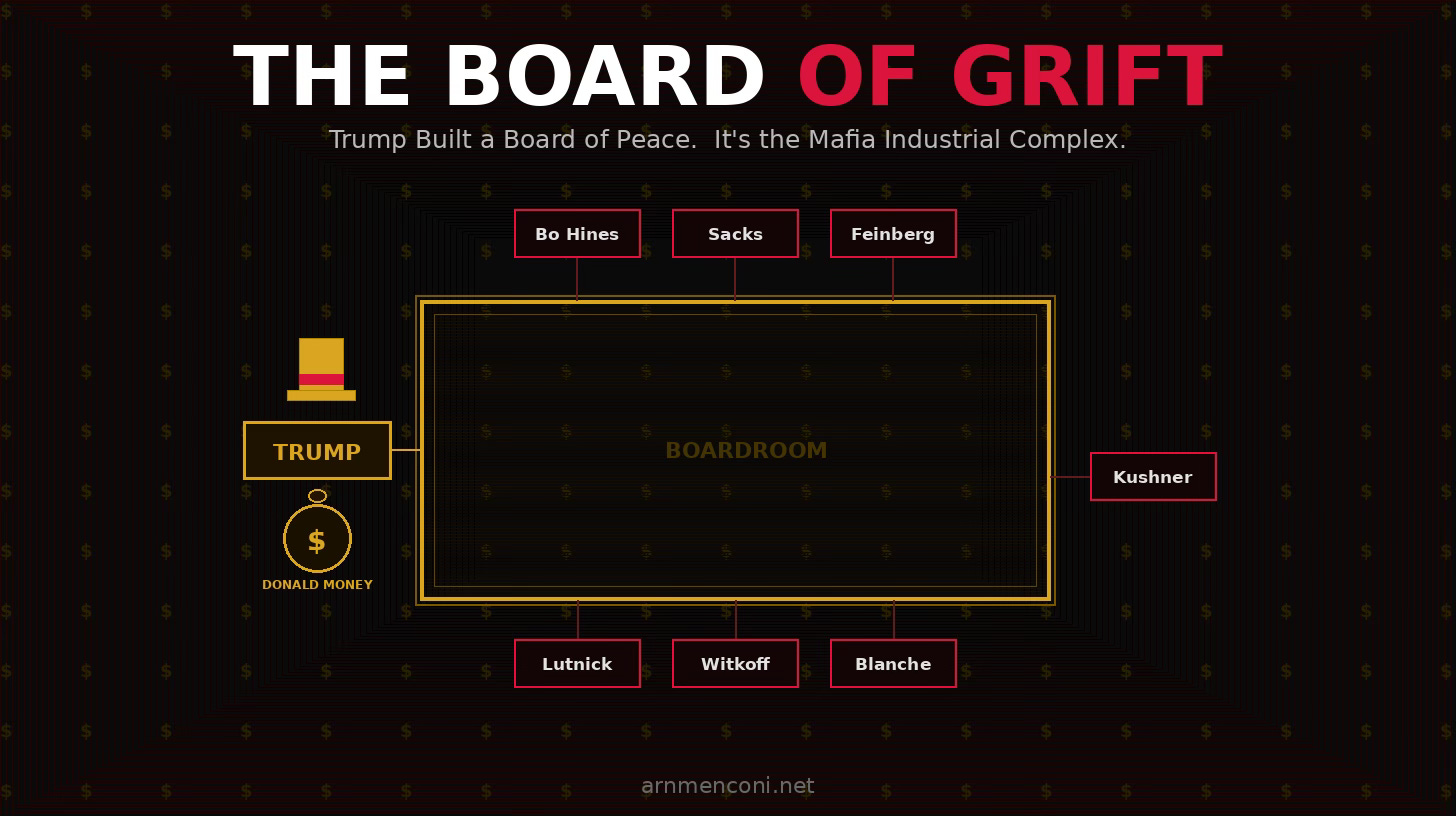
The Board
Bo Hines, 30 — CEO, Tether U.S.
Shaped the GENIUS Act at Trump’s White House — the law that forces every stablecoin to buy Treasury bills and bans paying interest to holders. Trump signed it July 18, 2025. Hines left August 9 — 22 days later. Tether hired him August 19 — 10 days after that. His investment firm NXUM Capital, co-founded with Goldman Sachs veteran Nav Singh and his father Todd Hines, donated $1 million to Trump’s super PAC one week before the 2024 election. The NXUM website has been scrubbed. The man who wrote the rule that says 550 million people earn zero on their savings is now running the company that keeps $10 billion a year in interest for itself.
Howard Lutnick — Commerce Secretary
Former CEO of Cantor Fitzgerald, which custodies Tether’s $141 billion in Treasury reserves. Cantor holds a 5% equity stake in Tether potentially worth $25 billion. Bloomberg reported Tether loaned his children’s trust the money to buy Cantor after he transferred ownership to comply with ethics rules. A Southern District of New York filing alleged he was “working full time for Tether” before taking office. His name appears in more than 250 Jeffrey Epstein documents. He admitted under oath to visiting Epstein’s island in 2012 — four years after Epstein’s conviction. He claimed on a podcast he cut ties in 2005. Senate testimony proved contact through 2014. The Atlantic: “Howard Lutnick’s Epstein Story Doesn’t Make Any Sense.” In early April, a senior White House official told reporters he’s on “thin ice.”
Steve Feinberg — Deputy Secretary of Defense
Co-founder of Cerberus Capital Management — $65 billion in assets, named after the three-headed dog that guards the gates of hell. Cerberus owns or has owned DynCorp (private military), Tier 1 Group (trained four members of the Saudi squad that assassinated journalist Jamal Khashoggi), Navistar Defense ($50 million fraud settlement), and TransDigm ($20.8 million in Pentagon price gouging). ProPublica reported that at least four companies awarded contracts under Feinberg’s $151 billion Golden Dome missile defense project are owned by Cerberus. He “divested” but keeps an indefinite contract to receive services from Cerberus. His defense investments fund a family trust for his children. The man whose company trained Khashoggi’s assassins is Trump’s man at the Pentagon.
Todd Blanche — Acting Attorney General (as of April 3, 2026)
Trump’s personal criminal defense attorney in three cases — hush money, January 6, classified documents. On April 3, Trump fired Pam Bondi over “management of Epstein documents” and handed the entire Department of Justice to his own lawyer. ProPublica revealed Blanche owned $159,000–$485,000 in crypto when he issued the April 7 memo disbanding the National Cryptocurrency Enforcement Team, ending all Biden-era crypto investigations, and calling enforcement “reckless.” His Bitcoin rose 34% before he “divested” by gifting it to his adult children and grandchild. Six senators accused him of a “glaring conflict of interest.” The Campaign Legal Center filed a criminal complaint — up to five years under 18 U.S.C. § 208(a). He personally interviewed Ghislaine Maxwell in prison. He now controls the Tether file and the Epstein file. Both of them. The same man.
David Sacks — Former AI/Crypto Czar, now PCAST Co-Chair
PayPal mafia. Co-architected the crypto regulatory framework with Hines. From his perch, the GENIUS Act, the CLARITY Act, the Strategic Bitcoin Reserve, and the SEC’s “most crypto assets are not securities” interpretation all took shape. Peter Thiel’s closest political ally. Thiel funds Palantir (Pentagon targeting), Anduril (autonomous weapons), and invested in Polymarket — the prediction market where people bet on whether the war will escalate.
Jared Kushner — Peace Envoy
Runs Affinity Partners — $6.2 billion under management, 99% from foreign investors. Raising $5 billion more from Saudi Arabia and the UAE — the same governments he’s simultaneously negotiating with as Trump’s peace envoy. Senator Ron Wyden: “not only criminal but endangering the lives of Americans.”
Zach Witkoff — CEO, World Liberty Financial
Son of Steve Witkoff, Trump’s Middle East envoy. World Liberty Financial is the Trump family’s stablecoin company. USD1 holds $5 billion in reserves. The UAE Royal Family owns 49%. On April 2, the younger Witkoff said the quiet part out loud: “You’ll be able to sell your equity tokens in real-world assets... You’ll be able to lend against those tokens and collateralize them.” Then he added: “The most-traded asset on Hyperliquid is actually tokenized oil.” Tokenized oil. The commodity that spikes every time his father’s peace negotiations collapse. His father negotiates the war. His company tokenizes the oil. Senator Elizabeth Warren called it a possible quid pro quo. It’s not possible. It’s the business model.
The Trump Family
Eric Trump and Donald Trump Jr. co-founded American Bitcoin Corp. Trump’s executive order mandates Bitcoin be mined in America. His administration created a Strategic Bitcoin Reserve seeded with $17 billion in seized assets. His signature goes on every new dollar bill starting June 2026. Forbes estimates the family’s combined net worth at $10 billion — nearly doubled since the election. When the Financial Times told Eric the family had made over $1 billion from crypto, he said: “Probably more.” When CNBC asked what drives them, Eric answered: “It’s gratifying to have this opportunity for retribution.” His name on the law. His name on the currency. His family’s name on the stablecoin. Retribution as business model.
The Firing
On April 3, Trump fired his Attorney General over Epstein documents and replaced her with his own criminal defense lawyer. The man who shut down crypto enforcement while holding crypto now controls the DOJ that holds both the Tether file and the Epstein file. Howard Lutnick’s name is in 250+ of those documents.
Representative Thomas Massie reviewed the unredacted files. He found six redacted men, including one “pretty high up in foreign government.” He said the DOJ is “already breaking the law” by not releasing them. Now the man controlling those files is the defendant’s own lawyer.
Think about that. Trump is under investigation. Trump fires the AG. Trump installs his own defense attorney as the new AG. That attorney now controls the evidence in the cases against his own former client. In any courtroom in America, that’s obstruction. In this White House, it’s a Thursday.
The Question
In 2008, Michael Lewis had to reconstruct the scam after it collapsed. He proved that the people who sold the mortgage derivatives knew they were garbage, bet against their own products, and got bailed out by the Treasury Secretary who used to run their firm.
This time, you don’t have to wait. The GENIUS Act is public. The FEC filings are public. The Bloomberg story is public. The ProPublica investigation is public. The revolving door is measured in calendar squares: 22 days, 10 days.
2008 was the Big Short. This is the Big Grift.
The only difference is they didn’t bother hiding it. They wrote it into law, signed it on camera, called it retribution, and the man who wrote it is running the company.
Read the law yourself. Section 4(a)(11). Then look at the board. Then follow the money. Then get angry. Because they’re counting on you not to.
Arn Menconi is a former two-term County Commissioner, MBA, and investigative journalist. He started in banking during the S&L crisis as a project manager for the Resolution Trust Corporation. He interviewed Daniel Ellsberg for 40 hours. He covered the Aspen Security Forum as credentialed press. Full investigation with 122 sources at arnmenconi.net.
Every claim in this article is sourced to Bloomberg, Reuters, CNBC, ProPublica, the Financial Times, Forbes, the Federal Reserve, BIS, the New Yorker, Axios, Fortune, and federal court filings.