

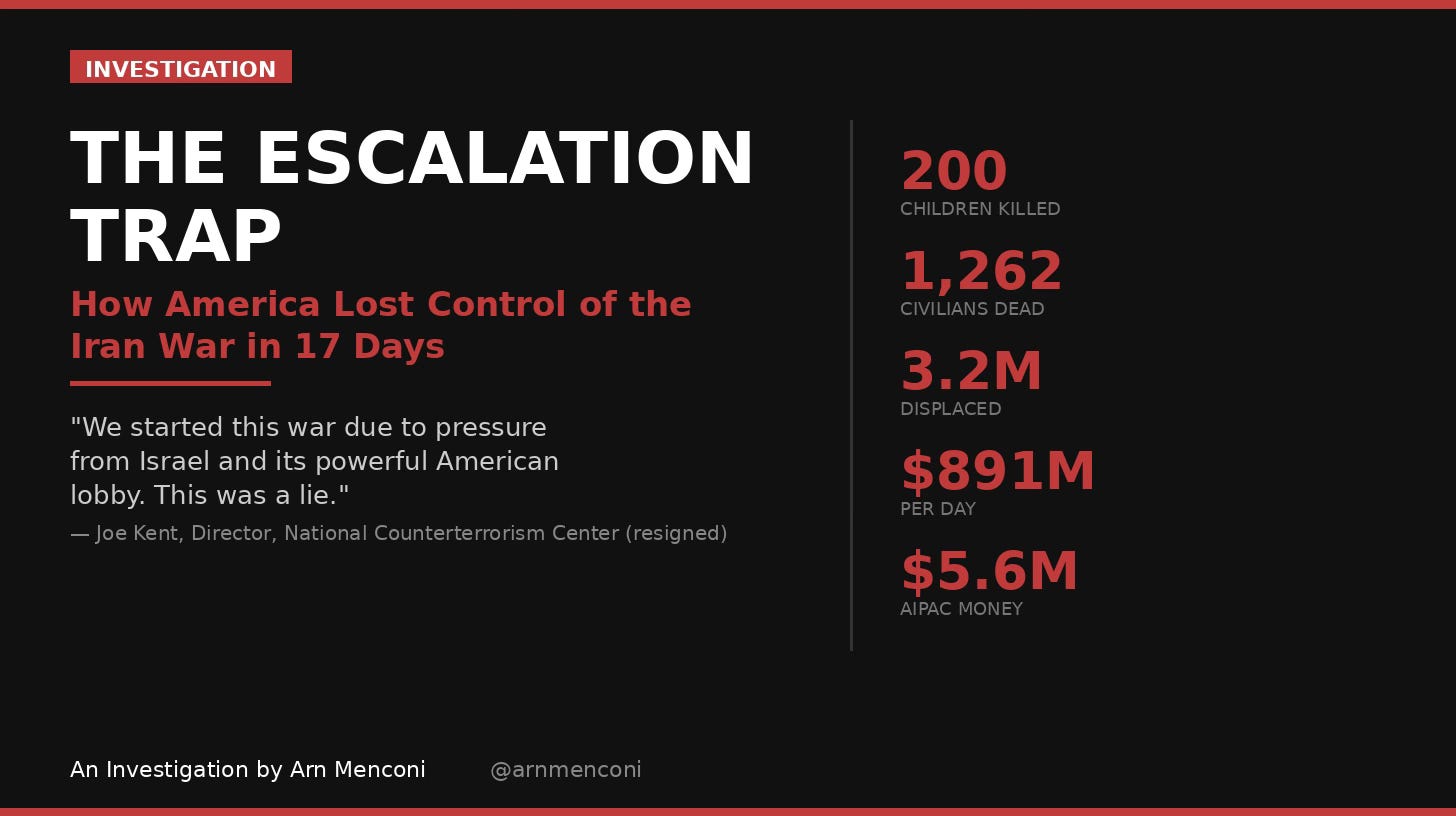
On the first day of the war, an American Tomahawk missile hit a school in the southern Iranian city of Minab. Iranian officials say 165 people died — mostly schoolgirls and their parents. By day eleven, at least 1,262 civilians were dead, including 200 children. Thirteen hospitals struck. Black rain fell on Tehran — soot and toxic chemicals from fuel depots bombed the night before — and the government told 14 million residents not to go outside. 3.2 million Iranians displaced. A hairdresser named Merve Pourkaz, 32, walked nearly a thousand miles from Golestan to the Turkish border. “If the war doesn’t end,” she told Fortune, “maybe I’ll go back and die.”
This is what a 75 percent probability of catastrophe looks like from the ground.
The Trap
Three days before the first bomb, Iran’s Foreign Minister announced a historic nuclear deal was “within reach.” An Omani mediator flew to DC twelve hours before the strikes to tell Vice President Vance the agreement was real: permanent end to enrichment stockpiling, full IAEA verification, the strongest framework since the JCPOA.
Trita Parsi, Executive Vice President of the Quincy Institute, documented the betrayal. “Iran had offered major nuclear concessions and Trump could have claimed a diplomatic victory,” Parsi told Al Jazeera. “Instead, he chose war.” Trump’s National Security Advisor was echoing Netanyahu’s demand for total dismantlement — a non-starter designed to kill the negotiation.
The United States bombed anyway.
Professor Robert Pape, the University of Chicago political scientist who has advised every White House since 9/11, calls what is unfolding the “escalation trap” — and gives a 75 percent probability that the United States is entering its worst stage.
Stage one: tactical success. Palantir’s Maven AI generated 1,000 targets in 24 hours — twice Iraq’s “Shock and Awe.” Pape’s response: “We’re stuck in a trap of our own making.”
Stage two: political blowback. The Supreme Leader we assassinated — Khamenei — had issued fatwas against nuclear weapons. He was a guardrail. His son Mojtaba has vowed to keep the Strait of Hormuz closed. Iran had enriched uranium for 16 nuclear weapons. That material has been dispersed to unknown locations across a country six times the size of Iraq. We killed the man who opposed the bomb. We cannot find the material.
Stage three: regime change. Boots on the ground in 400,000 square miles of mountainous terrain. Every simulation ends the same way.
Rula Jebreal has been covering this war with the clarity she brought to Israel’s destruction of Gaza. “This war will make Iraq look like a walk in the park,” she told Zeteo. Kushner’s justification — that a 60-year-old facility was enriching uranium — was contradicted by nuclear experts. “Trump’s justification for the war with Iran was based on a lie,” Jebreal wrote, “perpetuated by Jared Kushner.”
On March 17, the administration’s own Director of the National Counterterrorism Center confirmed it. Joe Kent — a veteran deployed 11 times, a Gold Star husband who lost his wife Shannon in a 2019 suicide bombing in Syria — resigned and posted his letter on X. “Iran posed no imminent threat to our nation,” he wrote, “and it is clear that we started this war due to pressure from Israel and its powerful American lobby.” He called the intelligence justification "a lie" and compared it to the tactics that drew the United States into Iraq — a war that, according to Brown University's Costs of War Project, has cost $2.1 trillion and killed over 300,000 people directly, with indirect deaths pushing the toll into the millions. The same playbook. The same lobby. Now they're running it again. Within hours, members of Congress called him antisemitic.
The man who ran America’s counterterrorism center says the war is a fraud. The people who fund it call him a bigot for saying so.
Who Pays for Silence
Not one of the 15 active U.S. and Israeli military operations — from Iran to Gaza to Lebanon to Somalia to Yemen — has received a congressional vote. The Senate rejected a war powers resolution 53-47. The House rejected it 219-212. AIPAC spent over $15 million on four Illinois congressional races in the same week.
Sixty percent of Americans opposed this war before the first bomb dropped — the most unpopular military launch in modern American history. And the institution designed to authorize war will not stop one.
Consider Colorado’s two Democratic senators — both former presidential candidates, both considered party moderates.
Senator Michael Bennet has not once called this war illegal. In seventeen days of bombing that has killed over 1,200 civilians including 200 children, Bennet’s public statements have addressed Paralympics medals, housing legislation, and labor unions. His strongest response to the war was a letter asking the Pentagon to “investigate” the school strike in Minab — procedural language designed to signal concern while committing to nothing.
Senator John Hickenlooper voted for the war powers resolution and called it “Trump’s illegal, directionless war.” The resolution failed. He has said nothing since.
Now look at who funds them — and what they own.
According to Federal Election Commission data compiled by OpenSecrets and Track AIPAC, Bennet has received $3.1 million from pro-Israel lobby groups over his career. AIPAC is his top organizational contributor. Blackstone Group — one of the world’s largest asset managers — is number two. The securities and investment industry has given him over $2 million.
Hickenlooper has taken $2.5 million from pro-Israel groups and $2.4 million from securities and investment firms. Between them: $5.6 million from the pro-Israel lobby, $4.5 million from the securities and investment industry.
But the donor money is only half the story. Hickenlooper’s 2024 financial disclosure, filed with the Senate, shows he personally holds $100,000 to $250,000 in RTX stock — formerly Raytheon Technologies, the company manufacturing the missiles being fired at Iran. RTX hit all-time highs when the bombing started. His household also holds Palantir Technologies — the company whose Maven AI system selected 1,000 bombing targets in the first 24 hours. And he holds $250,000 to $500,000 in JPMorgan Chase, one of 40 commercial banks piloting the tokenized financial system through the Bank for International Settlements’ Project Agora.
The Senator who called the war “illegal” and then went silent owns stock in the company making the missiles and the company running the kill chain. His portfolio went up when the bombs he claims to oppose started falling.
These are not outliers. They are the template. Most Senate Democrats are funded by the same industries — and most are just as silent.
Follow the Money
The Iran war costs $891 million per day. In 17 days: over $12 billion. The Penn Wharton Budget Model projects $40 to $95 billion over two months. Parsi’s estimate: a trillion dollars to reopen the Strait of Hormuz alone.
This is happening while the United States pays $1.04 trillion per year in interest on its national debt — more than the entire defense budget. The country is borrowing to bomb.
But the war is not just draining the treasury. It is creating the conditions for something else.
Oil has surged 40 percent. Brent crude topped $104. The International Energy Agency calls it the most significant disruption to global energy supplies ever recorded.
The GENIUS Act, signed by Trump in July 2025, requires stablecoin issuers to back every token with U.S. Treasuries — turning the crypto industry into a captive buyer of $38 trillion in sovereign debt. The White House says it explicitly: the law will “generate increased demand for U.S. debt and cement the dollar’s status as the global reserve currency.” BlackRock’s Larry Fink declared “the tokenization of all assets era” has arrived.
David Sacks, Trump’s AI and Crypto Czar: “Banks are going to get fully into crypto. It’s going to be one digital assets industry.” Today, the House Financial Services Committee holds a hearing titled “Tokenization and the Future of Securities.” The architects are testifying under oath.
Here is the chain: war destabilizes energy markets. Energy destabilization threatens the dollar. Dollar instability creates the pretext for emergency financial legislation. That legislation routes sovereign debt through tokenized assets controlled by private firms. Democratic oversight is replaced by automated ledger systems that governments do not control and citizens cannot audit.
The war is not just about oil. It is not just about what Israel and AIPAC have demanded for thirty years. It is about the transition from a debt-based dollar to what some analysts are calling the “Asset-Dollar” — a tokenized system that automates debt servicing, collateralizes national sovereignty, and transfers the architecture of global finance from democratic institutions to the same private asset managers funding Senate campaigns and filling Senate portfolios.
The bombs are the cover. The digital enclosure is the objective.
There are only 100 senators in the United States. Two hundred children are dead. 3.2 million people are displaced. The war is illegal, the economy is on a collision course, and the people with the constitutional authority to stop it are cashing checks and watching their portfolios rise.
A trillion here and a trillion there. Now we are talking about real money.
What You Can Do
Call Senator Michael Bennet: (202) 224-5852. Call Senator John Hickenlooper: (202) 224-5941. Call your own senators. Ask them one question: why are you silent?
Show up at their district offices. Occupy their waiting rooms. Bring the names of the 200 children killed in seventeen days and read them out loud.
Email every reporter covering this war and ask them why they haven’t followed the money — from AIPAC to the securities industry to the stock portfolios of the senators who refuse to say the word “illegal.”
Share this article. Tag @SenatorBennet. Tag @SenatorHick. Tag @jeremyscahill, @rulajebreal, @tparsi, @aaronjmate. Make them answer.
The war is funded by your taxes. The silence is funded by their donors. The only people not being paid are the ones with the power to stop it — you.
#IranWar #AIPAC #JoeKent #Tokenization #SenateDemocrats #copolitics #Raytheon #FollowTheMoney
Arn Menconi is a former county commissioner, MBA (University of Denver), and investigative journalist tracking the financial and human cost of U.S.-Israeli wars across 15 theaters. He managed a $100 million government budget in Colorado and a national nonprofit budget covering 8 states. In 2015, he spent 10 days at Daniel Ellsberg’s home and interviewed him for 40 hours on nuclear weapons and existential risk. He ran for U.S. Senate against Michael Bennet in Colorado in 2016. His book “Drifting Toward Extinction” is forthcoming. Contact: arn@arnmenconi.com | arnmenconi.net | @arnmenconi